
To mark the 75th anniversary of the adoption of the Refugee Convention, representatives of participating institutions and legal practitioners gathered at the Faculty of Law of Trnava University in Trnava at the end of October. The expert event was organized by the United Nations High Commissioner for Refugees (UNHCR), the Faculty of Law of Trnava University (TRUNI) and the Human Rights League (Liga za ľudské práva).
As Jun Shirato, UNHCR Representative a.i. for Poland, the Czech Republic, and Slovakia, noted in her opening remarks, when large-scale displacement occurs, no single individual or entity can respond alone. Everyone must help and coordinate their efforts.
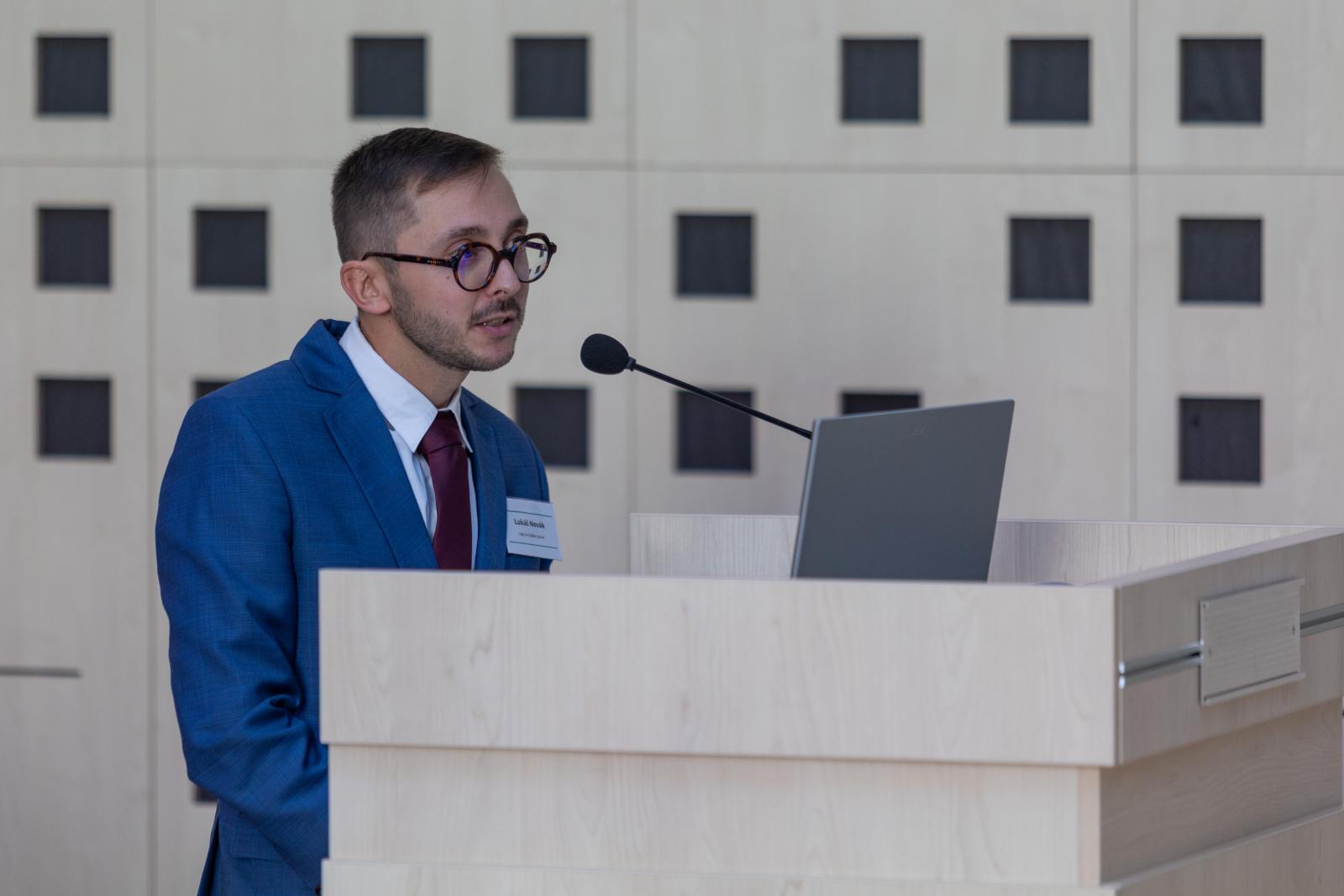
According to our Program Director, Lukáš Novák, this holds true even when asylum systems are under pressure, as people who have lost protection in their home countries still need to seek a safe haven.
Elena Berthotyová, a judge of the Supreme Administrative Court of the Slovak Republic, offered participants a look at the Refugee Convention through the eyes of an asylum judge. When judges balance strict legal provisions against a refugee's tragic fate, she emphasized that every decision must have a clear legal grounding.
Several key messages addressed by Judge Berthotyová to the audience in Trnava resonated strongly with us:
- The right to asylum is not a state privilege, but the fulfillment of an obligation we voluntarily undertook.
- The definition of a refugee is universal and timeless, it does not need to be changed, our attitude toward refugees is what needs to change.
- There must be no void between the refugee and the law, that void must be filled with justice shaped by reason and compassion.
The Legal Aid Centre was represented in Trnava by Martina Sukovská, who discussed landmark court decisions in asylum cases. Michaela Dojčinovičová, a lawyer for the Human Rights League, focused on membership of a particular social group as a ground for persecution. She highlighted the situation of women and girls who identify with values of equality incompatible with those enforced in their countries of origin, which under certain conditions can constitute membership of a particular social group.
When planning this event, we considered it crucial to directly involve people with lived experience of displacement in the dialogue. We are deeply grateful that our invitation was accepted by individuals who fled Afghanistan, Belarus, and Iraq and found a new home in Slovakia. We are glad that the Human Rights League was able to help them find a safe haven here in the past. Their testimonies served as direct proof of how vital international legal protection is.
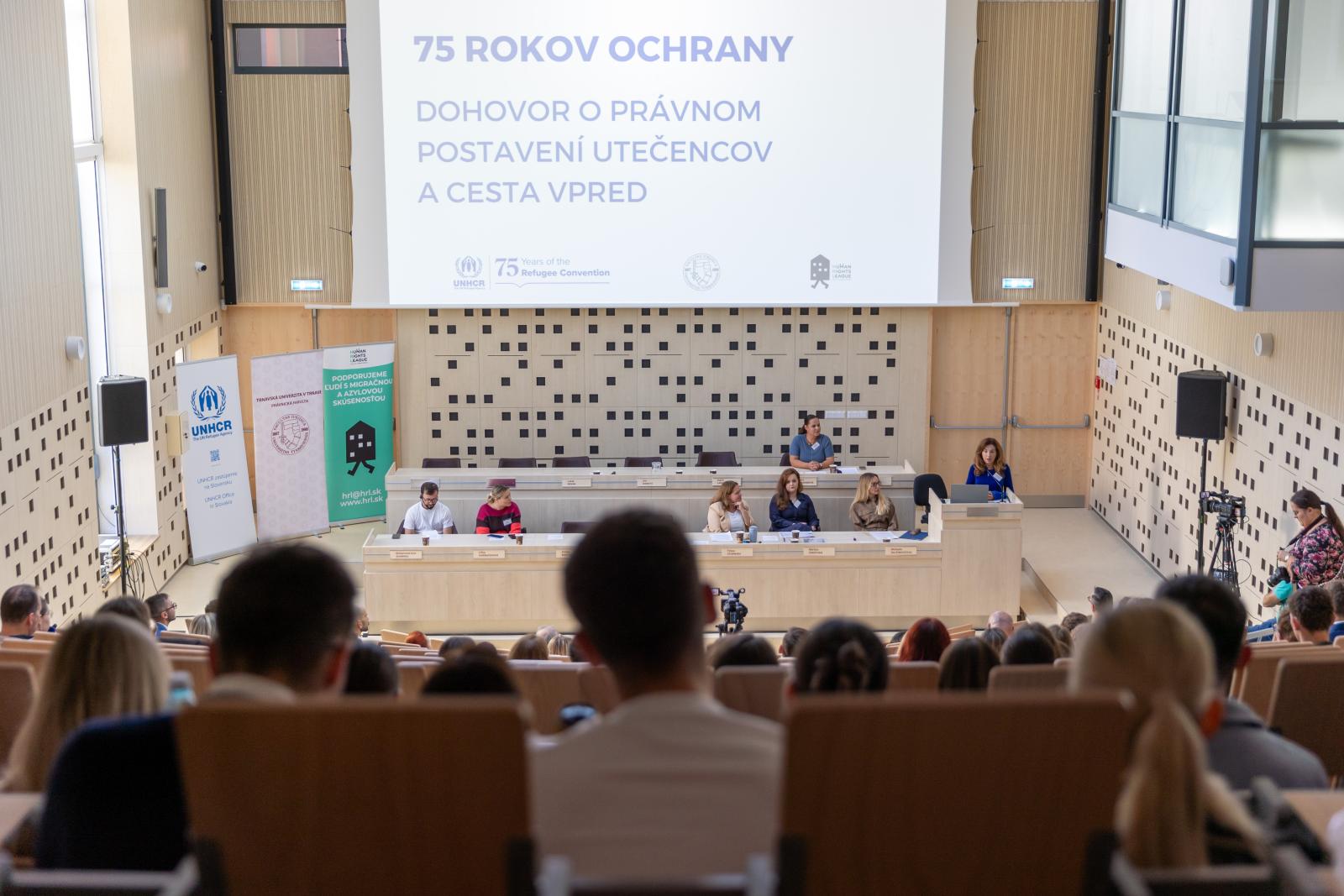
Finally, we discussed the origins and evolution of Slovakia’s asylum system. Personal experiences were shared by Iveta Zraková from the Migration Office of the Ministry of Interior of the Slovak Republic, international law expert Darina Macková and Ján Šikuta, former judge of the European Court of Human Rights and former UNHCR legal adviser.
They spoke about the challenging beginnings, when, for instance, information had to be verified by writing to embassies or in person without the internet. In the past, Slovakia lacked representation in countries of origin, and after the dissolution of the Soviet republics, many people found themselves stateless in a legal vacuum. However, multilateral cooperation compels the system to continuously improve. UNHCR assisted with implementation, and the civil society sector played a significant role. Students in the audience were encouraged to get involved, protect the system, and build upon it. The discussion was moderated by Miroslava Mittelmannová from the TRUNI Faculty of Law.
We plan to publish selected presentations as episodes on the Migration Compass (Migračný kompas) podcast in Slovak for those who could not attend in person. Subscribe to our newsletter to stay informed and receive a direct link to the recordings.


